

This Isn't Science Fiction
This Isn't Science Fiction


Joined:
X days ago
# Posts:
X,XXX
Contributor Points:
X


This Isn't Science Fiction This is for real, almost like an episode from any science fiction show. "NASA's Neil Gehrels Swift Observatory has been falling for years. Now it is falling fast. And a robotic spacecraft is racing to catch it before it burns up in Earth's atmosphere.
Swift launched in 2004 to study gamma-ray bursts - the most powerful explosions in the universe. When something sudden and violent happens in the sky - a star collapses, two neutron stars collide, a black hole devours a companion - Swift detects it within seconds and swivels its instruments to capture the event. It then sends coordinates to every major observatory on Earth, acting as a cosmic early-warning system. After 21 years of continuous operation, Swift has detected more than 1,600 gamma-ray bursts and become one of the most productive astrophysics missions in NASA's history.
But Swift has no thrusters. It was placed in a low Earth orbit at roughly 600 kilometers altitude and left to slowly descend as atmospheric drag tugs it downward. Over two decades, its orbit has decayed to approximately 400 kilometers. Recent peaks in solar activity have expanded Earth's upper atmosphere, dramatically increasing drag. Swift is now losing altitude so quickly that without intervention, it will reenter and be destroyed by the end of 2026. There is no replacement mission planned.
So NASA contracted a small company called Katalyst Space Technologies to build something that has never been attempted before - a robotic spacecraft called LINK that will autonomously rendezvous with Swift in orbit, grapple onto it, and use its own thrusters to push the telescope back up to a safe altitude. The entire rescue mission was designed, built, and tested in under eight months.
This photograph shows the LINK spacecraft at NASA's Wallops Flight Facility in Virginia on June 8, 2026, moments before being sealed inside a Northrop Grumman Pegasus XL rocket. The Pegasus XL is an air-launched vehicle - it is carried to 12,000 meters beneath the belly of a modified L-1011 airliner called Stargazer, then dropped and ignited in midair. It will deploy LINK from above Kwajalein Atoll in the Marshall Islands later this month.
If LINK succeeds, it will not only save Swift - it will prove that orbital servicing works. Future satellites that run out of fuel, lose altitude, or develop problems could be rescued by robotic missions instead of being abandoned. It would change how we think about every spacecraft we launch.
Right now, a telescope that has spent 21 years watching the most violent events in the universe is silently falling toward its own destruction. And a robot the size of a dishwasher, launched from underneath a plane over the Pacific Ocean, is humanity's only plan to save it.
Credit: NASA/Ron Beard
#space #astronomy #Artemis #NASA #fblifestyle #moon #Venus 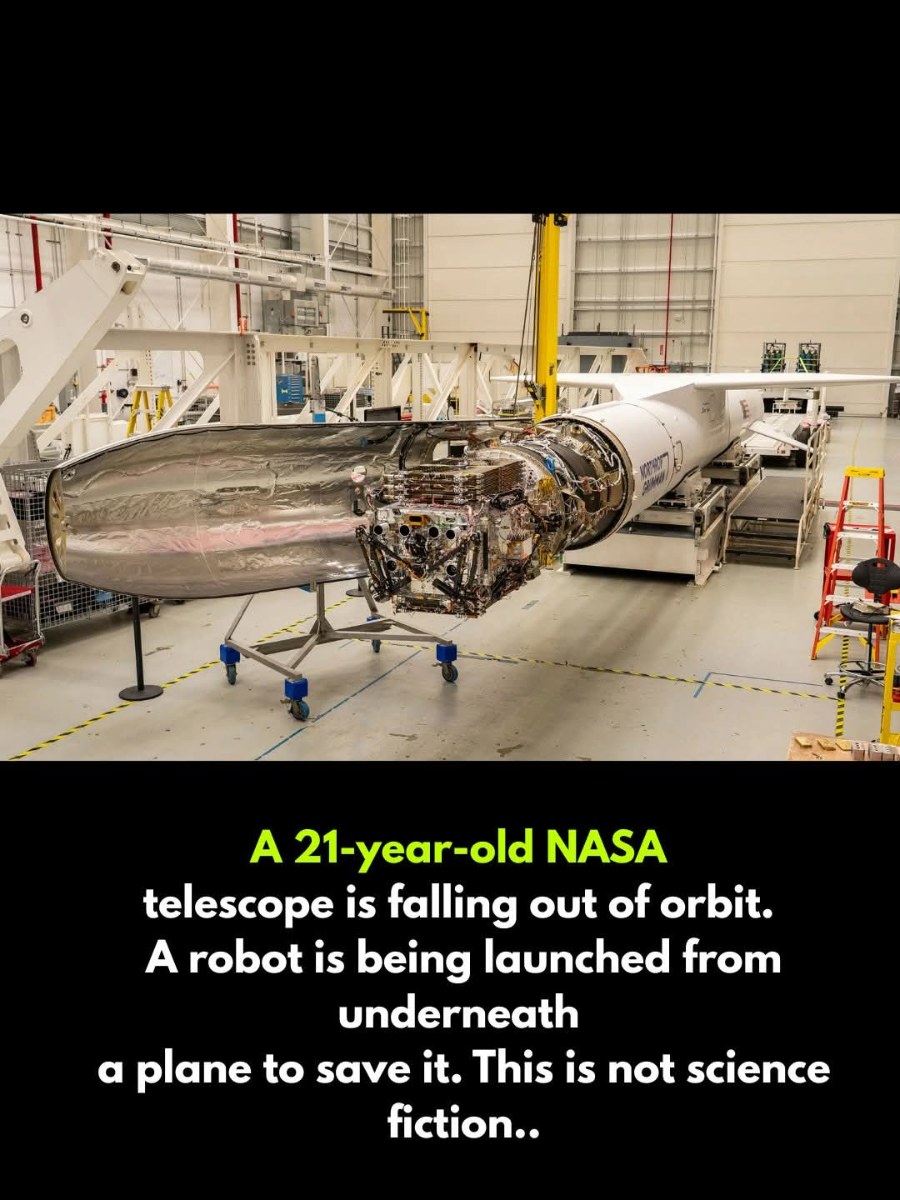
Swift launched in 2004 to study gamma-ray bursts - the most powerful explosions in the universe. When something sudden and violent happens in the sky - a star collapses, two neutron stars collide, a black hole devours a companion - Swift detects it within seconds and swivels its instruments to capture the event. It then sends coordinates to every major observatory on Earth, acting as a cosmic early-warning system. After 21 years of continuous operation, Swift has detected more than 1,600 gamma-ray bursts and become one of the most productive astrophysics missions in NASA's history.
But Swift has no thrusters. It was placed in a low Earth orbit at roughly 600 kilometers altitude and left to slowly descend as atmospheric drag tugs it downward. Over two decades, its orbit has decayed to approximately 400 kilometers. Recent peaks in solar activity have expanded Earth's upper atmosphere, dramatically increasing drag. Swift is now losing altitude so quickly that without intervention, it will reenter and be destroyed by the end of 2026. There is no replacement mission planned.
So NASA contracted a small company called Katalyst Space Technologies to build something that has never been attempted before - a robotic spacecraft called LINK that will autonomously rendezvous with Swift in orbit, grapple onto it, and use its own thrusters to push the telescope back up to a safe altitude. The entire rescue mission was designed, built, and tested in under eight months.
This photograph shows the LINK spacecraft at NASA's Wallops Flight Facility in Virginia on June 8, 2026, moments before being sealed inside a Northrop Grumman Pegasus XL rocket. The Pegasus XL is an air-launched vehicle - it is carried to 12,000 meters beneath the belly of a modified L-1011 airliner called Stargazer, then dropped and ignited in midair. It will deploy LINK from above Kwajalein Atoll in the Marshall Islands later this month.
If LINK succeeds, it will not only save Swift - it will prove that orbital servicing works. Future satellites that run out of fuel, lose altitude, or develop problems could be rescued by robotic missions instead of being abandoned. It would change how we think about every spacecraft we launch.
Right now, a telescope that has spent 21 years watching the most violent events in the universe is silently falling toward its own destruction. And a robot the size of a dishwasher, launched from underneath a plane over the Pacific Ocean, is humanity's only plan to save it.
Credit: NASA/Ron Beard
#space #astronomy #Artemis #NASA #fblifestyle #moon #Venus
Replies:
No replies yet. Be the first to respond below!
** Would you be interested in keeping up to date with news & events going on in the Peoria area? Consider supporting an alternative social media platform for Peoria by creating an account today! (it's fast, easy, privacy focused, and free!)
« Back to Chat
Views: 13
# Replies: 0