DennisinPeoria
:
ChatGPT:
You're referring to a new proposal near Texas Road, south of Oak Hill and near Hanna City. The company, Lapis Carbon Solutions, is considering an injection well that would take most of its CO₂ from BioUrja's Peoria ethanol plant. The proposal is still at an early stage: Lapis has not applied for the required EPA Class VI injection permit, and a test well is meant to find out whether the site's geology is suitable.
What "burying CO₂" means
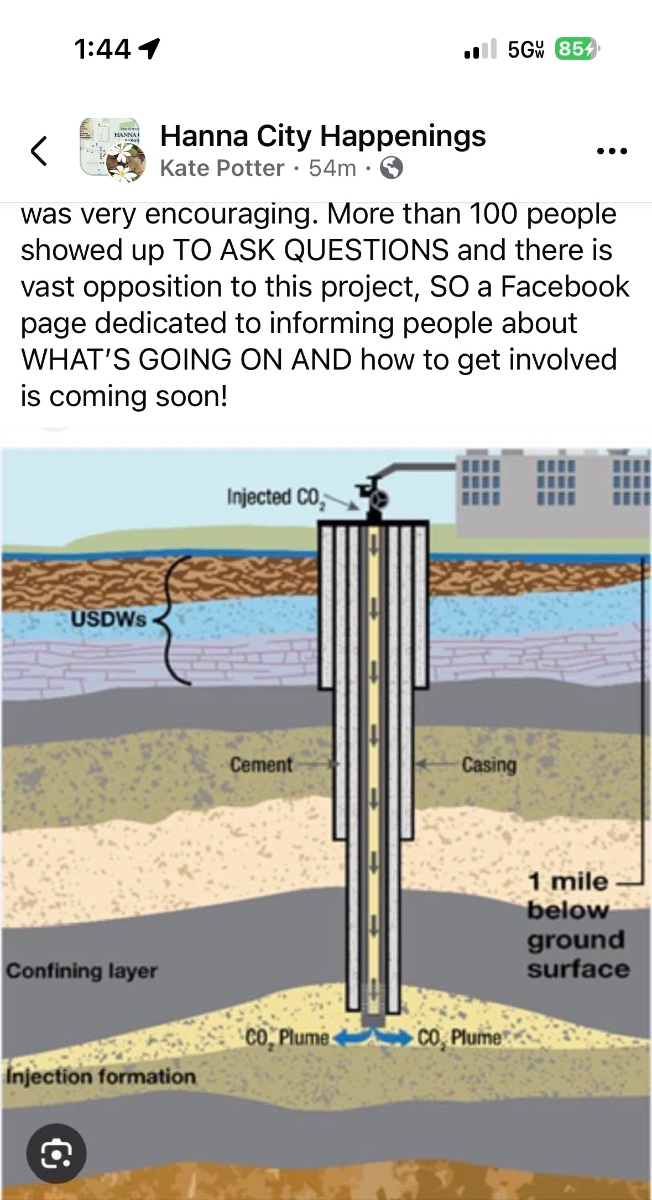
BioUrja would capture carbon dioxide produced during ethanol making, then ship it by truck to a receiving site. The proposal estimates 50-60 trucks a day. There, the CO₂ would be stored, heated and injected more than 3,000 feet underground into porous Mount Simon Sandstone. A layer of Eau Claire Shale above it is intended to act as a seal. The plan calls for about 425,000 metric tons a year for 12 years-roughly 5.1 million tons if it runs as proposed.
At that depth, the CO₂ is a dense fluid that fills pores in the rock. The idea is to keep it underground: the seal rock blocks its upward movement, and some CO₂ can become trapped in the pores, dissolve into salty water underground or eventually react with rock minerals. It isn't a cavern or a tank full of gas.
Possible effects
* Climate: Capturing CO₂ that would otherwise be released from the ethanol plant could reduce emissions, if the CO₂ stays underground and the project's full energy and transport costs don't erase much of that benefit. EPA describes this type of storage as a way to reduce CO₂ emissions to the atmosphere.
* Nearby roads and the site: The truck traffic is a direct local effect-noise, congestion, road wear and the ordinary risks of heavy vehicles. The article also describes a possible receiving terminal and, in one option, a short pipeline to the well.
* Groundwater and geology: The main underground concerns are whether CO₂ or salty formation water could escape through a faulty well, a fault or a fracture, and whether injection pressure could trigger small earthquakes. EPA's permit rules require site studies, well and groundwater monitoring, emergency plans, and monitoring after injection stops; they're designed to identify and control those risks, though the proposal's test and permitting work still have to establish whether this particular site is suitable.
* A release at the surface: Concentrated CO₂ can displace oxygen and be dangerous to people or animals nearby. That's a different scenario from normal operation deep underground, but it's why well integrity and emergency planning matter.
There's a relevant Illinois precedent, though it doesn't tell us how this proposed site would perform: at ADM's Decatur project, EPA found in 2024 that injected CO₂ had moved into unauthorized underground zones after corrosion in a monitoring well. Reuters reported that ADM said the incident had not affected surface or groundwater or threatened public health.
So this is a proposed industrial project with a potential climate benefit and real questions about truck traffic, site geology, groundwater protection and long-term monitoring. It is not approved or operating yet, and the test well and EPA review are key steps before anyone can say whether this site is appropriate.